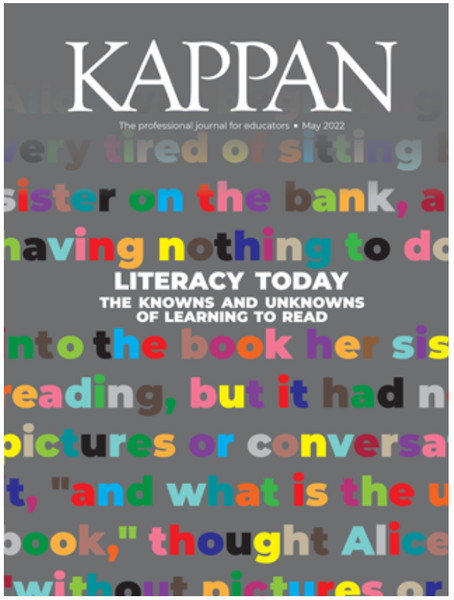
Phi Delta Kappan / Editorial

Enough already with the reading wars

Back in the early 1990s, I worked for a year as a research assistant to a team of scholars — led by the researcher Catherine Snow — who were in the midst of a long-term study of literacy development among children from low-income backgrounds, following their progress from preschool through high school. At the time, the children were in 1st grade, and my job was to visit them both at home and in school to assess their emergent reading skills, observe classroom instruction, interview their parents
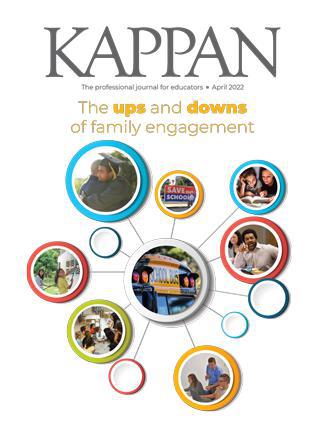
Parents and teachers: In sync or at odds?

For more than 150 years, American parents have had a complex, push-pull relationship with the people who educate their children. As the historian William Cutler (2000) explains, “Parents and teachers have often vied with each other for influence and authority” over what children should learn in which settings and under whose direction. At times, Cutler explains, “the American tradition of local control has placed teachers at the mercy of parents and taxpayers” to decide what content and skills s

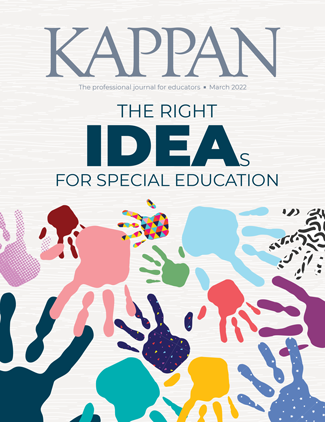
Big questions about special education

The Individuals with Disabilities Education Act (IDEA) — along with its predecessor, the Education for All Handicapped Children Act (EHA) — is widely viewed as one of the 20th century’s most important pieces of civil rights legislation. When EHA was passed in 1975 (with strong bipartisan support), it opened the doors of the nation’s schoolhouses to millions of children who’d long been denied access to public education, while also creating many of the resources and legal protections that children

Let’s be careful out there

Every job comes with its own set of interpersonal challenges. As a magazine editor, for instance, I work closely with authors to help them revise and polish the articles they’ve submitted for publication. If you’ve ever been asked to give people feedback on their writing, then I’m sure you understand how delicate and uncertain this work can be — delicate because most writers feel deeply invested in and sensitive about their writing; uncertain because no two writers are sensitive in the same way.

Time to invest in rural education

Writing in Kappan’s December 1983 issue, guest editor Jonathan Sher noted that rural children have long been “relegated to the back of the American school bus.” Rural people in general, he added, have been exploited for generations, first as low-paid labor in agriculture, coal mining, and other sectors, and then as low-paid labor lured away to work in urban factories. While political and economic elites have always been happy to celebrate the virtues of rural life (and to buy vacation homes in r

A better start for teachers

In the spring, it appeared that the nation’s schoolteachers might steer clear of the Great Resignation, this year’s unprecedented surge in workers choosing to quit rather than stay in stressful or unfulfilling jobs (Barnum, 2021). Since then, however, public education — just like health care, transportation, and other sectors — has been hit by a wave of resignations and retirements, leaving administrators scrambling to find replacements. As a recent story by AP News puts it, “Now that schools ha

A new day for young children?

As I write this column, in late-August, the United States Congress is gearing up for a budget reconciliation process that will (if Nancy Pelosi, Chuck Schumer, and colleagues can manage to keep all House and Senate Democrats on the same page) result in a truly historic federal investment in early care and education. The starting point for negotiations is President Joe Biden’s $3.5-trillion spending plan, which includes a proposed $200 billion to support universal public preK programs and another

The seduction of school choice

The question isn’t whether school choice is good or bad in general, but what do we actually know about the specifics of school choice?

According to the legal scholar Martha Minow (2011), there have been at least four distinct school choice movements in the United States over the last hundred years. In the 1920s (at a time when many public schools were hostile environments for non-Protestants and immigrant students), Catholics, Jews, and other religious minorities secured the legal right to opt

The ambiguity of extra

Ask a random American to name some of the extracurricular activities commonly offered by the nation’s public schools, and they’ll rattle them off easily enough: the jazz band, gymnastics, baseball, yearbook, Future Farmers of America, the debate team, the robotics club, and on and on. But ask them why these particular activities are offered as extracurriculars, as opposed to regular classes, and they’ll likely respond with a blank stare.

Sure, we all know that the rules are different for extrac

The beginning of a beautiful friendship?

Writing in 1997, the historian Ellen Condiffe Lagemann noted that since the field of education research emerged, in the early 20th century, “[it] has grown tremendously. . . and has undergone many changes in goal, method, focus, and definition.” The only thing that hasn’t changed, she added, is “the constancy with which the enterprise has been subjected to criticism.” Decade after decade, its detractors keep airing the same complaints: Much of the research is shoddy, and researchers make too lit

On ed tech, let’s meet in the middle

One day, a few years ago, I went to buy a power cord at the local Best Buy, and I noticed they had put a virtual reality headset out on the counter for customers to try. At that point, I had read a bit about VR — enough to make me curious — so I went over and put on the headset. Instantly, I found myself in a cavernous theater, near the stage, as several Cirque du Soleil acrobats assembled themselves into an elaborate human pyramid, just 10 or 12 feet from where I stood. Oh my God, I thought (or

Let the children persuade

Two decades ago, during a brief stint working in a teacher preparation program, I got to know a young man who struck me as an exceptionally promising educator. Tom was a top student in the university’s English department, a gifted writer, and, according to his supervising instructor at the local high school, far and away the best student teacher she had seen in her 40 years in the classroom. With our glowing recommendations in hand, he soon found a job teaching in a district not far from where h

The economics of talent development

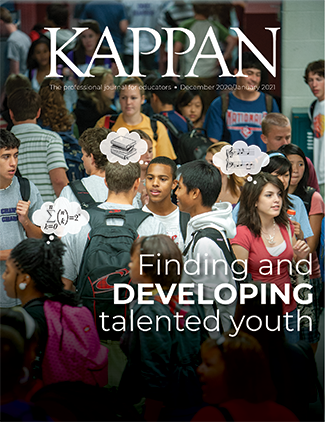
When we planned this issue of Kappan, my colleagues and I expected that it would focus on the research into how best to identify and support the millions of American students who are ready for a greater level of academic challenge, whether or not they belong to the 5-6% of the population who meet the usual criteria for “giftedness.” And, by and large, that is exactly what our contributors have done, in articles that review what’s known about the effectiveness of advanced educational programs, ho

The many meanings of good

Almost every year since the mid-1990s, the PDK poll has asked American adults to grade both their local public schools and the country’s public schools overall. The findings have been remarkably consistent: Year after year, most parents tell us that the school their own child attends is quite good, but they believe most other schools to be mediocre or worse. In 2019, for instance, 76% of parents said they would give their child’s school a grade of A or B, but just 19% of respondents would give a

Who controls the market?

According to the National Center for Education Statistics (2020), local, state, and federal spending on public elementary and secondary schools adds up to roughly $740 billion per year, with 80% going toward salaries and pensions and another 2% wrapped up in fixed costs related to building maintenance, taxes, and the like. That leaves the not-insignificant sum of about $133 billion per year to be spent on services (such as organizational consulting, achievement testing, and teacher development p

How will teachers manage to teach this year?

I’ve borrowed the title of this column from a well-known article by the teacher/researcher Magdalene Lampert (1985), who has written often and eloquently about the complexities of everyday life in classrooms. Like many others who’ve published richly observed analyses of teaching practice, Lampert provides a compelling alternative to the story that most K-12 reformers like to tell about what goes on in schools and what it will take for schools to improve.

Time and again, prominent researchers an

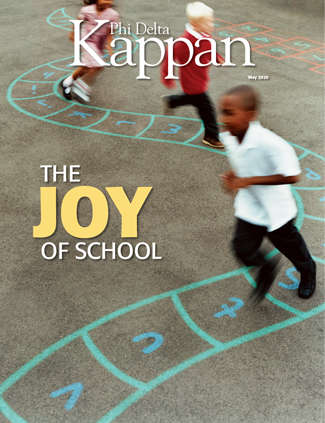
An ode to joy

It was early in 2019 when my colleagues and I decided that this month’s Kappan would focus on joyfulness in K-12 education. We reasoned that at the end of a publishing year that featured some unhappy topics — including an issue on toxic stress, for instance, and one on the many professional challenges teachers face — readers would be eager for more uplifting content. But we never dreamed that in May 2020 we’d be in the middle of a global pandemic, schools would be shuttered, and the last thing o

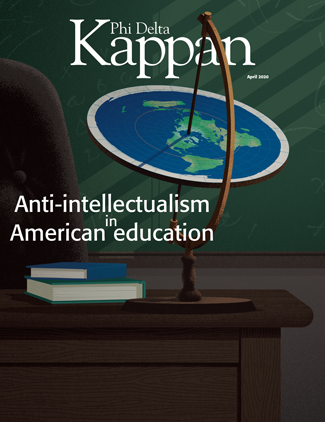
A republic of dunces?

Has intellectual life in America declined to a new low? Tom Nichols, a professor of national security affairs at the U.S. Naval War College, certainly thinks so. As he writes in his 2017 best seller, The Death of Expertise, our “foundational knowledge” about history, geography, science, and many other subjects “has crashed through the floor of ‘uninformed,’ passed ‘misinformed’ on the way down, and is now plummeting to ‘aggressively wrong.’ ”

Thanks to Google and Wikipedia, argues Nichols, ever

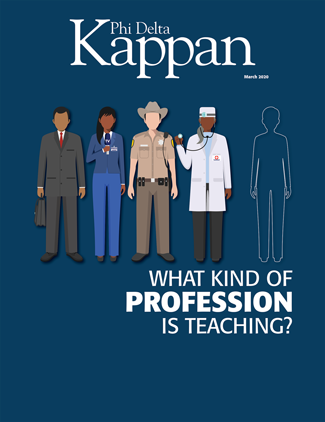
A profession in process

This month’s Kappan focuses on an especially timely question: “What kind of profession is teaching?” As I write this column, thousands of Florida’s teachers have just concluded a one-day rally in Tallahassee to press legislators to boost education spending. Recent months have seen similar rallies and strikes in several other states and in dozens of cities and towns, focusing not just on funding and salary increases but also on a number of other professional concerns, having to do with school res

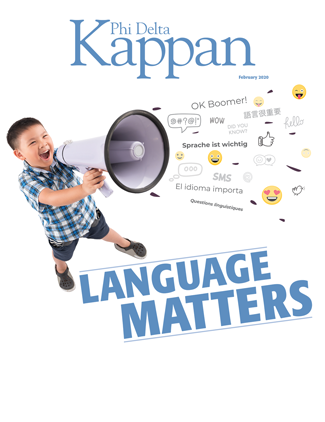
A love-hate affair with language

It’s a bit of a cliche to compare the history of education reforms to the movement of a pendulum, but there’s no better way to describe educators’ long-standing debates about children’s language development. Consider, for example, the endless repetition of the same few arguments about how best to teach reading in the early grades: Today (as George Hruby explains in this issue of Kappan), intensive phonics instruction appears to be on one of its periodic upswings, while schools neglect other kind

It ain’t easy to change the narrative

Back in the 1990s, when I was in graduate school studying rhetoric and writing instruction, my colleagues and I had a big chip on our shoulders. As we saw it, rhetorical education is the lifeblood of deliberative democracy. Because an open society relies on the back-and-forth of arguments and counterarguments to determine the best course of action, nothing could be more important than to teach young people to argue persuasively (and to be open to others’ persuasive arguments). Outside of our gra

One nation under stress

According to Gallup’s (2019) most recent international survey of emotional health, Americans are more frazzled than ever before. On any given day, roughly 55% of us say we feel highly stressed. (Only the citizens of Greece, the Philippines, and Tanzania report higher rates.)

What’s gotten into us? It’s complicated, says the eminent Stanford University biologist Robert Sapolsky, who has spent nearly four decades studying stress, its causes, and its effects. On one hand, stress hormones help huma

From what it’s not to what it is

Since the Every Student Succeeds Act (ESSA) was passed in December 2015, policy debates about the law have focused not so much on what it is, but what it isn’t, not what it achieves but what it undoes. As Sen. Lamar Alexander (R-TN) remarked in early 2016, ESSA reins in the federal government’s power to influence education at the state and local levels, “revers[ing] the trend toward what had become, in effect, a national school board” under No Child Left Behind (NCLB). “The new law,” he went on,

Nowhere to go but up

Here at PDK headquarters, we were startled and stunned by the results of last year’s poll: For the first time since 1969, when we began surveying Americans on their attitudes toward the public schools, the majority of respondents (54%) said they would not want their children to become teachers.

How could this be? For half a century, our polling data had assured us that whatever the challenges facing K-12 education, teaching remained a desirable career. As recently as 2011, nearly 70% of poll re
Load More